objc-msg-arm.s
objc-msg-arm64.s
objc-runtime-new.mm
其他: Runtime 源码索引
源码中数据为汇编, 勉强阅读
这里以网上其他文章做索引帮助理解
参考文章:
深入汇编探索objc_msgSend (老源码, 易于理解, 只讲完消息查找, 无 动态解析 和 消息转发 流程)
iOS 底层拾遗:objc_msgSend 与方法缓存(老源码, 源码说明不如上文清晰, 优势在 缓存机制 讲的比较清楚)
深入浅出 Runtime(三):消息机制 (老源码, 整体流程介绍的十分透彻)
Objective-C 消息发送与转发机制原理 | yulingtianxia’s blog (老源码, 需要有汇编和反编译基础)里面涉及的其他基础概念在我之前的其他文章里:
tagged pointer: 其他: Tagged pointer 与 isa
isa: 其他:探究 isa 的指向
总结
objc_msgSend 整体分为三个流程:
- 消息查找
- 汇编: 缓存中查找
- C++: 遍历函数表查找(排过序用二分, 未排序用遍历)
- C++: 遍历父类函数表查找
- 消息动态解析
- C++: 非元类调用开发实现的
resolveInstanceMethod - C++: 元类调用开发实现的
resolveClassMethod再调用resolveInstanceMethod - C++: 重新执行消息查找(只在查找缓存)
- C++: 非元类调用开发实现的
- 消息转发(不在
runtime, 在CoreFoundation中)- OC: 调用
forwardingTargetForSelector尝试找下一个 Target 接收 , (NSObject 默认return nil) - OC: 上一步失败调用
methodSignatureForSelector,打包函数签名 - OC: 调用
forwardInvocation处理打包的签名(NSObject 打印unrecognized selector)
- OC: 调用
整体流程图:
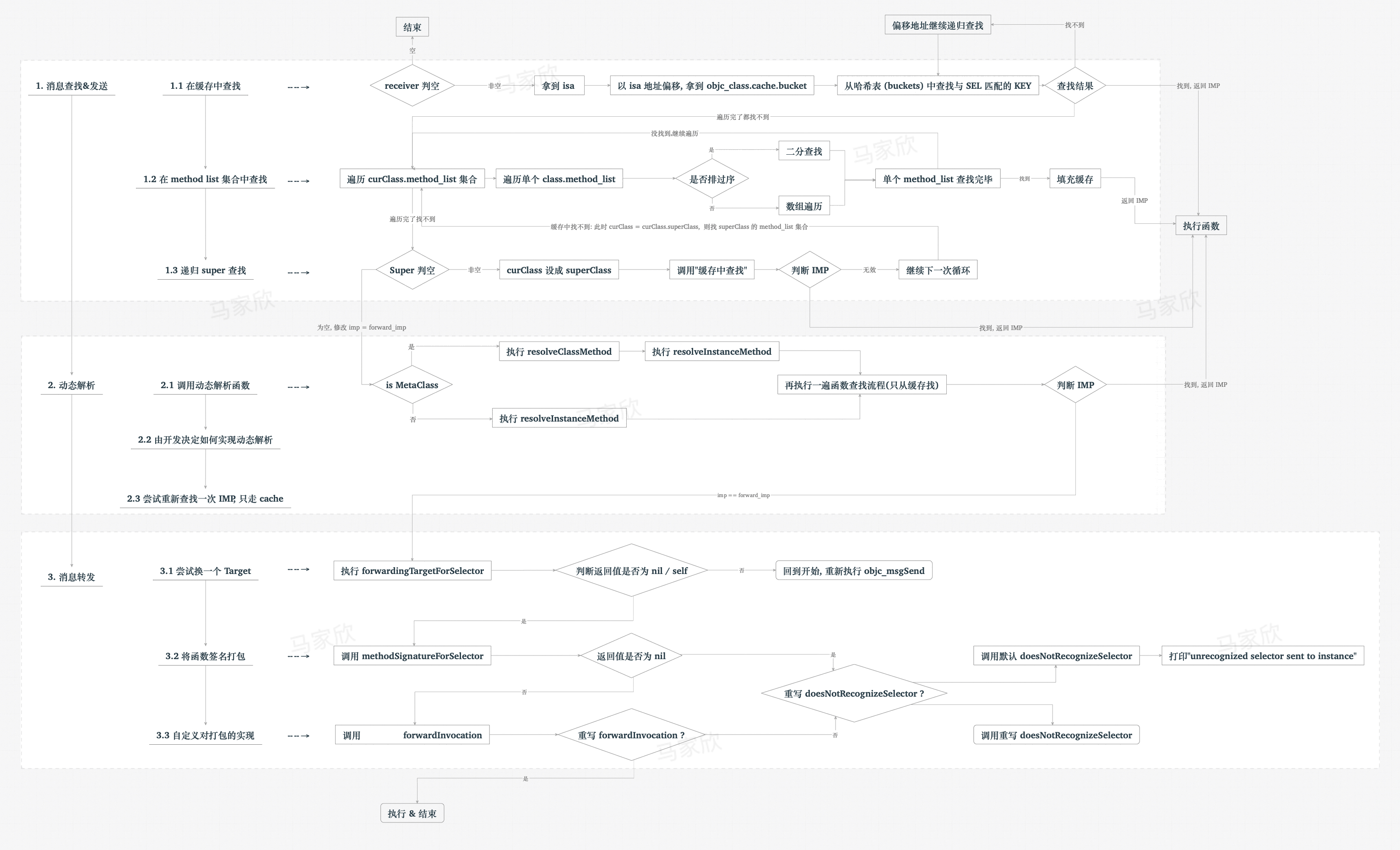
objc_msgSend 源码主线流程
- arm64 汇编代码会出现很多
p字母,实际上是一个宏,64 位下是x,32 位下是w,p就是寄存器。 - 阅读时, 直接点开源码, 对着源码阅读
- 入口
ENTRY _objc_msgSend - 判断消息接收者是否为空: p0(第一个入参) , 是的话走
LNilOrTagged或LReturnZero, 不是的话继续往下cmp p0, #0 // nil check and tagged pointer check #if SUPPORT_TAGGED_POINTERS b.le LNilOrTagged // (MSB tagged pointer looks negative) #else b.eq LReturnZero #endif - 获取到 isa 指向的地址: 把 isa 放到寄存器 13 (前文提过, isa 是
tagged pointer, 存了指针, 但本身不等同于指针)ldr p13, [x0] // p13 = isa - 使用 isa 获取 class 地址放到 16: 其他: 源码中 objc_msgSend 分析 -
GetClassFromIsa_p16
(isa 除了指针外还有别的数据, 前文提到过的 Tagged Pointer, 这里通过掩码方式直接取出 isa 存的指针)GetClassFromIsa_p16 p13 // p16 = class - 核心部分,调用
CacheLookup, 开始查找IMPCacheLookup NORMAL, _objc_msgSend - 后面的
LNilOrTagged,LReturnZero暂略, 弄完主线有时间再看, 可以理解为是处理 ISA 和空值情况
- 入口
🔴没弄懂的内容:
LGetIsaDone:的意思是否是锚点?
如果是锚点, 那代码最终会走到LReturnZero:后面, 即使是有效值, 因为没有从CacheLookup跳到最后一局的, 如果不是锚点, 那这段只有跳过来才会执行? 那CacheLookup就没机会调用了, 也是矛盾的
🟢已经搞懂了: 是锚点, 汇编没有函数入栈出栈, 不像高级语言, 代码跳走了就真的是跳走, 不回来的, 所以不会执行到LReturnZero:
CacheLookup: 缓存中找函数
- 先是几个之前寄存器的值, 0 = self, 1 = SEL, 16 = isa
// - x0 contains the receiver // - x1 contains the selector // - x16 contains the isa - 找到 objc_class.cache.buckets
回顾struct objc_class的数据结构, 这里将objc_class.cache.buckets拿出来- 继承的
struct objc_object内部有一个 isa 8 字节 Class为struct objc_class *, 结构体指针 8 字节- 所以
objc_class的第 16 个字节开始就是cache, - cache 的开头是
_buckets: 结构体指针 8 个字节,mask_occupied是uint32: 4 个字节//objc-runtime-new.h struct objc_class : objc_object { Class superclass; cache_t cache; // formerly cache pointer and vtable class_data_bits_t bits; // ... } typedef uint32_t mask_t; struct cache_t { #if CACHE_MASK_STORAGE == CACHE_MASK_STORAGE_OUTLINED explicit_atomic<struct bucket_t *> _buckets; mask_t _mask; mask_t _occupied; }最上面定义了,
CACHE为两个 pointer 的大小, 就是 16//objc-msg-arm64.s #define CACHE (2 * __SIZEOF_POINTER__)此处在拿到 cache 然后放到 p11 中, cache 的前 8 个字节是 buckets; 所以 p11 是 buckets
//objc-msg-arm64.s
 // p1 = SEL, p16 = isa
 ldr	p11, [x16, #CACHE]				// p11 = mask|buckets
- 继承的
- 从buckets哈希表中, 找到了 IMP 的地址, 放到 p12中, 找到哈希表中的 KEY,放到 p9 中
这里通过一些系列计算, 中间过程即使结合了参考文章, 看着也很吃力. 这里暂时只有操作的结论
#if CACHE_MASK_STORAGE == CACHE_MASK_STORAGE_HIGH_16
	and	p10, p11, #0x0000ffffffffffff	// p10 = buckets
	and	p12, p1, p11, LSR #48		// x12 = _cmd & mask
#elif CACHE_MASK_STORAGE == CACHE_MASK_STORAGE_LOW_4
	and	p10, p11, #~0xf			// p10 = buckets
	and	p11, p11, #0xf			// p11 = maskShift
	mov	p12, #0xffff
	lsr	p11, p12, p11				// p11 = mask = 0xffff >> p11
	and	p12, p1, p11				// x12 = _cmd & mask
#else
#error Unsupported cache mask storage for ARM64.
#endif
	add	p12, p10, p12, LSL #(1+PTRSHIFT)
		             // p12 = buckets + ((_cmd & mask) << (1+PTRSHIFT))
	ldp	p17, p9, [x12]		// {imp, sel} = *bucket
1:	cmp	p9, p1			// if (bucket->sel != _cmd)
	b.ne	2f			//     scan more
	CacheHit $0			// call or return imp

2:	// not hit: p12 = not-hit bucket
	CheckMiss $0			// miss if bucket->sel == 0
	cmp	p12, p10		// wrap if bucket == buckets
	b.eq	3f
	ldp	p17, p9, [x12, #-BUCKET_SIZE]!	// {imp, sel} = *--bucket
	b	1b			// loop
3:	// wrap: p12 = first bucket, w11 = mask
#if CACHE_MASK_STORAGE == CACHE_MASK_STORAGE_HIGH_16
	add	p12, p12, p11, LSR #(48 - (1+PTRSHIFT))
					// p12 = buckets + (mask << 1+PTRSHIFT)
#elif CACHE_MASK_STORAGE == CACHE_MASK_STORAGE_LOW_4
	add	p12, p12, p11, LSL #(1+PTRSHIFT)
					// p12 = buckets + (mask << 1+PTRSHIFT)
#else
#error Unsupported cache mask storage for ARM64.
#endif
	// Clone scanning loop to miss instead of hang when cache is corrupt.
	// The slow path may detect any corruption and halt later.
	ldp	p17, p9, [x12]		// {imp, sel} = *bucket
4.对比 入参 SEL 与 HASH 的 SEL, 判断是 CacheHit 找到 IMP 并执行, 还是 CheckMiss 继续找或开始查函数表
使用 p9 中 hash 表中的 SEL 与之前 p1 的做对比:
CacheHit: 成功找到缓存, 根据开始时调用CacheLookup的入参, 一般是直接通过TailCallCachedImp直接调用 IMPCheckMiss: 没找到, 就递归到下一个 bucket, 如果最终还是没找到, 就会调用JumpMiss, 开始查类的函数表
ps.CheckMiss是找不到的情况, 往前位移继续找重复 1 的过程, 后面不赘述. 直接看成功&失败
1:	cmp	p9, p1			// if (bucket->sel != _cmd)
	b.ne	2f			//     scan more
	CacheHit $0			// call or return imp

2:	// not hit: p12 = not-hit bucket
	CheckMiss $0			// miss if bucket->sel == 0
	cmp	p12, p10		// wrap if bucket == buckets
	b.eq	3f
	ldp	p17, p9, [x12, #-BUCKET_SIZE]!	// {imp, sel} = *--bucket
	b	1b			// loop

LLookupEnd$1:
LLookupRecover$1:
3:	// double wrap
	JumpMiss $0

.endmacro
5.CacheHit: 执行找到的 IMP
根据开始LookupCache 开始时入参, 执行不同函数, 一般是 TailCallCachedImp 直接调用 IMP 的过程
TailCallCachedImp在arm64-asm.h是个很短的宏
.macro CacheHit
.if $0 == NORMAL
  TailCallCachedImp x17, x12, x1, x16 // authenticate and call imp
.elseif $0 == GETIMP
  //...
  AuthAndResignAsIMP x0, x12, x1, x16 // authenticate imp and re-sign as IMP
9:  ret       // return IMP
.elseif $0 == LOOKUP
	  //...
  AuthAndResignAsIMP x17, x12, x1, x16  // authenticate imp and re-sign as IMP
  ret       // return imp via x17
.else
.abort oops
.endmacro
6.JumpMiss: 缓存中找不到, 开始在函数表中查找
直接走 __objc_msgSend_uncached
只关注 NORMAL 因为 objc_SendMsg 就是传 NORMAL
.macro JumpMiss
.if $0 == GETIMP
  b LGetImpMiss
.elseif $0 == NORMAL
  b __objc_msgSend_uncached
.elseif $0 == LOOKUP
  b __objc_msgLookup_uncached
.else
.abort oops
.endif
.endmacro
7.函数表中找 IMP 并执行
1. MethodTableLookup
2. TailCallFunctionPointer
  STATIC_ENTRY __objc_msgSend_uncached
  UNWIND __objc_msgSend_uncached, FrameWithNoSaves

  // THIS IS NOT A CALLABLE C FUNCTION
  // Out-of-band p16 is the class to search

  MethodTableLookup
  TailCallFunctionPointer x17

  END_ENTRY __objc_msgSend_uncached
MethodTableLookup: 类的函数表中找函数
核心是 _lookUpImpOrForward , 这是一个 C++ 中的函数
其他的看描述,是在操作变量和存放 IMP?
.macro MethodTableLookup
  // push frame
	 ...
  // save parameter registers: x0..x8, q0..q7
  ...
  // lookUpImpOrForward(obj, sel, cls, LOOKUP_INITIALIZE | LOOKUP_RESOLVER)
  // receiver and selector already in x0 and x1
	 ...
  bl  _lookUpImpOrForward
  // IMP in x0
  ...
  // restore registers and return
  ...
  AuthenticateLR

.endmacro
_lookUpImpOrForward: 真正开始的 IMP 查找
- 入参与返回值:
- 返回值: IMP 证明这个函数最后结果是找到 IMP 并返回
-
入参:
id inst(class 的实例),SEL sel,Class cls,int behavior(可以理解为当前状态的枚举值)
(behavior 在旧版中是bool initialize, bool cache, bool resolver三个参数, 现在合为了一个, 在实际判断时, 用&操作符, 取出某一部分做判断int behavior) - 一些判断状态的准备工作:
- 解开 Debug 锁: 源码中看不出干嘛的, 暂时根据名字推测是 debug 用的锁
( 其他: 源码中 objc_msgSend 分析 -assertUnlocked)runtimeLock.assertUnlocked(); - 判断是否需要使用缓存(从
objc_sendMsg进来的已经判断过了)
走缓存的实际上最后走到 CacheLookup: 其他: 源码中 objc_msgSend 分析 -_cache_getImp// Optimistic cache lookup if (fastpath(behavior & LOOKUP_CACHE)) { imp = cache_getImp(cls, sel); if (imp) goto done_nolock; } - 检查并处理类结构体本身: 检查 cls 是否已实现, 检查 cls 是否已创建, 如果没有, 则做对应处理
// 源码中有解释, 目的是先上个锁避免 cls 在检查和处理过程中发生变化
// 因为是运行时, cls 随时可能发生变化
runtimeLock.lock();
checkIsKnownClass(cls);
if (slowpath(!cls->isRealized())) {
 cls = realizeClassMaybeSwiftAndLeaveLocked(cls, runtimeLock);
}
if (slowpath((behavior & LOOKUP_INITIALIZE) && !cls->isInitialized())) {
 cls = initializeAndLeaveLocked(cls, inst, runtimeLock);
}
- 解开 Debug 锁: 源码中看不出干嘛的, 暂时根据名字推测是 debug 用的锁
- 开始查询 IMP:
外层 for 循环, 内层:- 先在 cls 自己的函数表查,调用
getMethodNoSuper_nolock查到的话直接结束
( 其他: 源码中 objc_msgSend 分析 -getMethodNoSuper_nolock:查找 cls 中的 Method ) - 然后
curClass = curClass->superclass指向父类, 并且不为空, 继续 3, 否则到 5 - 调用
cache_getImp在缓存里查, 查到了直接结束, 否则循环到 1 - 父类都查空,或者别的啥意外, 则到 5
- imp = forward_imp;(一个用于告知要走消息转发的标记)
注意: 无论如何 imp 都会有值for (unsigned attempts = unreasonableClassCount();;) { // 1: 查自己的 Method 列表 Method meth = getMethodNoSuper_nolock(curClass, sel); if (meth) { imp = meth->imp; goto done; } // 2: 查自己查不到, 把自己变成父类: 如果没有父类, 直接结束 , 如果有,到 3 if (slowpath((curClass = curClass->superclass) == nil)) { // No implementation found, and method resolver didn't help. // Use forwarding. imp = forward_imp; break; } // Halt if there is a cycle in the superclass chain. if (slowpath(--attempts == 0)) { _objc_fatal("Memory corruption in class list."); } // 3: 从cache 里拿(这是 cls 已经在 2 变成了前一刻的父类), cache 拿不到, 就下一个循环到 1 imp = cache_getImp(curClass, sel); // 前面如果被设成了 forward_imp, 怎么已经所有办法都试过了, 还是查不到,直接结束 if (slowpath(imp == forward_imp)) { // Found a forward:: entry in a superclass. // Stop searching, but don't cache yet; call method // resolver for this class first. break; } // 如果查到有效的 imp, 那就结束 if (fastpath(imp)) { // Found the method in a superclass. Cache it in this class. goto done; } }
- 先在 cls 自己的函数表查,调用
- 拿到有效 IMP 后, 填充缓存, 解锁
done: log_and_fill_cache(cls, imp, sel, inst, curClass); runtimeLock.unlock(); return imp; - 若没拿到有效的 IMP, 则走消息转发流程
上一步, 若是找到 IMP 会跳转到 done: 若是最后找不到, 则会出循环, 执行下面的语句
因为我有个地方没搞懂, 汇编在调用lookupIMPorForward时给的behavior没看懂, 只能根据注释和其他文章说法判断
其他: 源码中 objc_msgSend 分析 -resolveMethod_locked: 消息转发流程
//objc-msg-arm64.s
// lookUpImpOrForward(obj, sel, cls, LOOKUP_INITIALIZE | LOOKUP_RESOLVER)

//objc-runtime-new.mm
 // No implementation found. Try method resolver once.
if (slowpath(behavior & LOOKUP_RESOLVER)) {
    behavior ^= LOOKUP_RESOLVER;
    return resolveMethod_locked(inst, sel, cls, behavior);
}
getMethodNoSuper_nolock:在 cls 中遍历 data 里的 Method_list
这个没啥说的, 核心就是遍历:
从 cls->data() 中循环拿 method_list(clas 中 data 存了很多个 method_list, 而 method_list 又是 method 的集合. 具体看数据结构那章)
再调用 search_method_list_inline 从 method_list 中找 IMP
static method_t * getMethodNoSuper_nolock(Class cls, SEL sel) {
    runtimeLock.assertLocked();
    ASSERT(cls->isRealized());
    auto const methods = cls->data()->methods();
    for (auto mlists = methods.beginLists(), end = methods.endLists();
         mlists != end; ++mlists) {
        method_t *m = search_method_list_inline(*mlists, sel);
        if (m) return m;
    }
    return nil;
}
search_method_list_inline: 在 Method_list 中找 IMP
很明显,一个 if-else, 分两种情况, 排过序的调用findMethodInSortedMethodList, 没排过序的直接遍历ALWAYS_INLINE static method_t * search_method_list_inline(const method_list_t *mlist, SEL sel) { int methodListIsFixedUp = mlist->isFixedUp(); int methodListHasExpectedSize = mlist->entsize() == sizeof(method_t); if (fastpath(methodListIsFixedUp && methodListHasExpectedSize)) { return findMethodInSortedMethodList(sel, mlist); } else { // Linear search of unsorted method list for (auto& meth : *mlist) { if (meth.name == sel) return &meth; } } }findMethodInSortedMethodList: 使用二分查找在 Method_list 中找排过序的 IMPcount = list->countcount 为链表长度count >> 1二进制的右移一位, 数据大小每次少一半probe = base +(count >> 1): probe 每次从整体中间开始(假设 count = 100, probe 从 50 开始, base 从 0 开始)if (keyValue == probeValue): if 内的语句是,如果找到了, 一直 while 到相等并且最小的那个, 然后返回if (keyValue > probeValue): 如果要找的值比左半边最大值probe都大, 则 base 从 probe+1 开始,因为 base=count»1 +1, 所以 count 总数要 - 1, base+count 才是不越界的坐标
(base = 51, count= 100-1=99, 99»=1 = 49)
ALWAYS_INLINE static method_t *findMethodInSortedMethodList(SEL key, const method_list_t *list)
{
    ASSERT(list);

    const method_t * const first = &list->first;
    const method_t *base = first;
    const method_t *probe;
    uintptr_t keyValue = (uintptr_t)key;
    uint32_t count;

    for (count = list->count; count != 0; count >>= 1) {
        probe = base + (count >> 1);

        uintptr_t probeValue = (uintptr_t)probe->name;

        if (keyValue == probeValue) {
            // `probe` is a match.
            // Rewind looking for the *first* occurrence of this value.
            // This is required for correct category overrides.
            while (probe > first && keyValue == (uintptr_t)probe[-1].name) {
                probe--;
            }
            return (method_t *)probe;
        }

        if (keyValue > probeValue) {
            base = probe + 1;
            count--;
        }
    }

    return nil;
}
resolveMethod_locked: 动态解析流程
- 如果是元类
! cls->isMetaClass()走resolveInstanceMethod - 如果是类走
resolveClassMethod - 上面两个函数, 目的都是调用一个给开发自定义的函数, 把函数添加到类的函数表里
- 所以 return 时还再执行一次
lookUpImpOrForward让函数执行(ps 注意入参LOOKUP_CACHE, 避免死循环递归用的)static NEVER_INLINE IMP resolveMethod_locked(id inst, SEL sel, Class cls, int behavior) { if (! cls->isMetaClass()) { resolveInstanceMethod(inst, sel, cls); } else { resolveClassMethod(inst, sel, cls); if (!lookUpImpOrNil(inst, sel, cls)) { // ⚠️ 如果 cls 是元类, 那这函数属于元类的实例的方法, 所以还要执行一次resolveInstanceMethod // ⚠️ 其实不是特别明白 resolveInstanceMethod(inst, sel, cls); } } return lookUpImpOrForward(inst, sel, cls, behavior | LOOKUP_CACHE); }
resolveInstanceMethod: 动态解析对象的函数
- 先不看源码里的
resolveInstanceMethod, 这里@selector(resolveInstanceMethod:)其实跟外面 OC 拿 SEL 的流程一样的 - 不管当前在执行的是啥函数, 这里先执行一次 objc_msgSend, send 的消息是
resolveInstanceMethod, 参数是 sel - 这个
resolveInstanceMethod具体由开发决定怎么实现, (一般是将 sel 加入类函数表中)SEL resolve_sel = @selector(resolveInstanceMethod:); BOOL (*msg)(Class, SEL, SEL) = (typeof(msg))objc_msgSend; bool resolved = msg(cls, resolve_sel, sel); - 然后再尝试将,当前调用的函数缓存起来(方式是执行一次
lookUpImpOrNil) - 这里再次注意, 上面说过
resolveInstanceMethod是由开发自己实现, 所以开发完全可以将这个 sel 添加到函数表中 - imp 的作用只是后面打 log, 实质
lookUpImpOrNil的结果不影响运行// Cache the result (good or bad) so the resolver doesn't fire next time. // +resolveInstanceMethod adds to self a.k.a. cls IMP imp = lookUpImpOrNil(inst, sel, cls);
resolveClassMethod: 动态解析类的函数
大同小异, 多了一些判断类已实现的操作, 并且执行的对象是 metaclass
BOOL (*msg)(Class, SEL, SEL) = (typeof(msg))objc_msgSend;
bool resolved = msg(nonmeta, @selector(resolveClassMethod:), sel);
IMP imp = lookUpImpOrNil(inst, sel, cls);
动态解析找不到, imp 被设为_objc_msgForward_impcache, 进入消息转发流程
_objc_msgForward_impcache 是一个函数指针, 在前面代码中可以看到, _lookUpImpOrForward 从开始就会给 IMP 默认值设为这个指针.
消息转发: 这部分代码不在 runtime 中, 根据资料其实现于 CoreFoundation 框架. 要用反编译才能追踪
我追查 _objc_msgForward_impcache, 最终断链在 __objc_forward_handler
OC:
_objc_msgForward_impcache-> 汇编:__objc_msgForward-> 汇编:__objc_forward_handler-> C++:objc_defaultForwardHandler
objc_defaultForwardHandler. 里面有个很熟悉的语句:unrecognized selector sent to instance打日志并 crash
之后涉及到反编译后反汇编内容, 结论都来自于参考文章:
- 找一个新的 Target: 调用
forwardingTargetForSelector返回新的receiver- 新的 Target 有效: 用新的 target 执行消息
- 新的 Target 无效: (
nil/self) 下一步
- 调用
methodSignatureForSelector生成NSInvocation, - 再调用
forwardInvocation处理NSInvocation对象 - 若类本身都未实现, 则默认执行
doesNotRecognizeSelector
(NSObject 实现了forwardInvocation并默认调用doesNotRecognizeSelector)+ (void)forwardInvocation:(NSInvocation *)invocation { [self doesNotRecognizeSelector:(invocation ? [invocation selector] : 0)]; } - (void)forwardInvocation:(NSInvocation *)invocation { [self doesNotRecognizeSelector:(invocation ? [invocation selector] : 0)]; }
可以用于实现多继承: Message Forwarding
其他: 中途调用其他细节代码分析
GetClassFromIsa_p16
本质就是 isa and(&) ISA_MASK
代码很长, 这里不过度细究. 内容是对于 3 种不同的 isa 不同的处理方式. 这里只看 64 位下的
.macro GetClassFromIsa_p16 /* src */
...
#elif __LP64__
  // 64-bit packed isa
  and p16, $0, #ISA_MASK
#else
...
.endmacro
assertUnlocked
//objc-os.h
void assertUnlocked() {
    lockdebug_mutex_assert_unlocked(this);
}
//objc-lockdebug.mm
void lockdebug_mutex_assert_unlocked(mutex_t *lock)
{
    auto& locks = ownedLocks();
    if (hasLock(locks, lock, MUTEX)) {
        _objc_fatal("mutex incorrectly locked");
    }
}
_cache_getImp
STATIC_ENTRY _cache_getImp
  GetClassFromIsa_p16 p0
  CacheLookup GETIMP, _cache_getImp
LGetImpMiss:
  mov p0, #0
  ret

  END_ENTRY _cache_getImp